
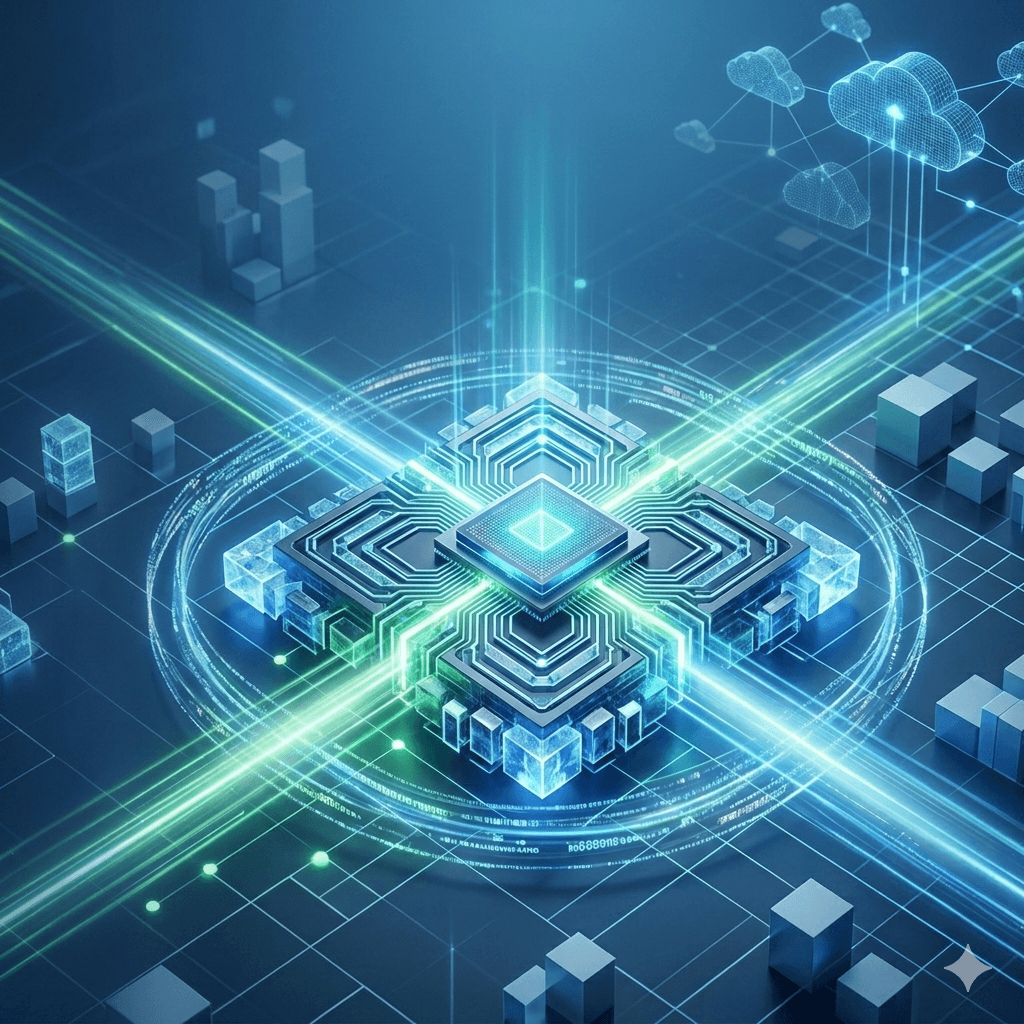

Microsoft has announced a monumental milestone in the race for quantum supremacy, revealing a new quantum computing chip designed entirely using advanced artificial intelligence. The breakthrough represents a profound convergence of the world’s two most powerful computational fields: generative AI and quantum physics. By leveraging deep learning models to overcome engineering bottlenecks that have stalled researchers for years, Microsoft has significantly accelerated its hardware timeline, confidently projecting the deployment of commercially viable quantum systems by 2029.
AI Breaks the Quantum Bottleneck
Building a reliable quantum processor has long been one of humanity’s most complex engineering challenges. Traditional quantum chips rely on qubits, which are notoriously unstable and prone to environmental interference, resulting in computational calculation errors. To solve this, Microsoft utilized specialized AI models trained on complex materials science and quantum mechanics data. The AI autonomously evaluated millions of atomic arrangements and structural designs, ultimately engineering a stabilized chip architecture that human engineers would have taken decades to discover manually.
The Power of Majorana Qubits
At the heart of Microsoft’s new AI-designed chip is the deployment of topological qubits, specifically utilizing the unique properties of Majorana fermions. Unlike standard superconducting qubits used by competitors, topological qubits feature inherent hardware-level protection against external noise. By using AI to meticulously map out the ultra-precise nanostructures required to stabilize these fragile states, Microsoft has successfully mitigated the "noise" problem. This brings the industry a massive step closer to achieving fault-tolerant quantum computing, where errors are corrected automatically at the physical level.
Driving a Materials Science Revolution
The implications of an AI-designed quantum processor extend far beyond just faster computing speeds. Microsoft’s platform is designed to act as a catalyst for a global materials science revolution. With the computational foundation laid by this new chip, future systems will be capable of simulating molecular interactions at an exact quantum level. This will compress centuries of trial-and-error chemistry into mere days, allowing scientists to design highly efficient electric vehicle batteries, discover life-saving therapeutics, and develop green fertilizers to fight global climate change.
The Roadmap to 2029
Microsoft's aggressive timeline places the delivery of a fault-tolerant quantum supercomputer by 2029. This strategic roadmap transitions the technology out of isolated experimental research laboratories and embeds it directly into the commercial tech ecosystem. According to Microsoft’s projections, the 2029 systems will seamlessly integrate with Azure Quantum, allowing enterprises, research universities, and global governments to access quantum-accelerated cloud infrastructure alongside traditional high-performance computing (HPC) workflows.
Cloud Integration and Hybrid Workloads
To ensure the 2029 rollout is highly practical for commercial deployment, Microsoft is heavily focusing on hybrid classical-quantum infrastructure. The upcoming systems will not operate in a vacuum; instead, they will be paired directly with Microsoft’s massive AI data centers. By offloading hyper-complex equations to the quantum chip while letting classical AI processors handle data sorting and user interfaces, businesses will be able to run high-level cryptographic, logistic, and financial optimization workloads with minimal latency.
Establishing the Next Epoch of Computing
"The pairing of artificial intelligence and quantum mechanics marks the definitive beginning of a new paradigm in human problem-solving..."
By hitting its internal engineering benchmarks ahead of schedule, Microsoft is positioning itself to define the next epoch of global computing infrastructure. The announcement signals to the broader tech industry that AI is no longer just a software tool for writing code or generating images, but a critical driver of next-generation physical hardware. As Microsoft begins fabricating these AI-designed topological chips, the countdown to 2029 is officially underway, promising to reshape technology, science, and global industry forever.
NEVER MISS A THING!
Subscribe and get freshly baked articles. Join the community!
Join the newsletter to receive the latest updates in your inbox.


