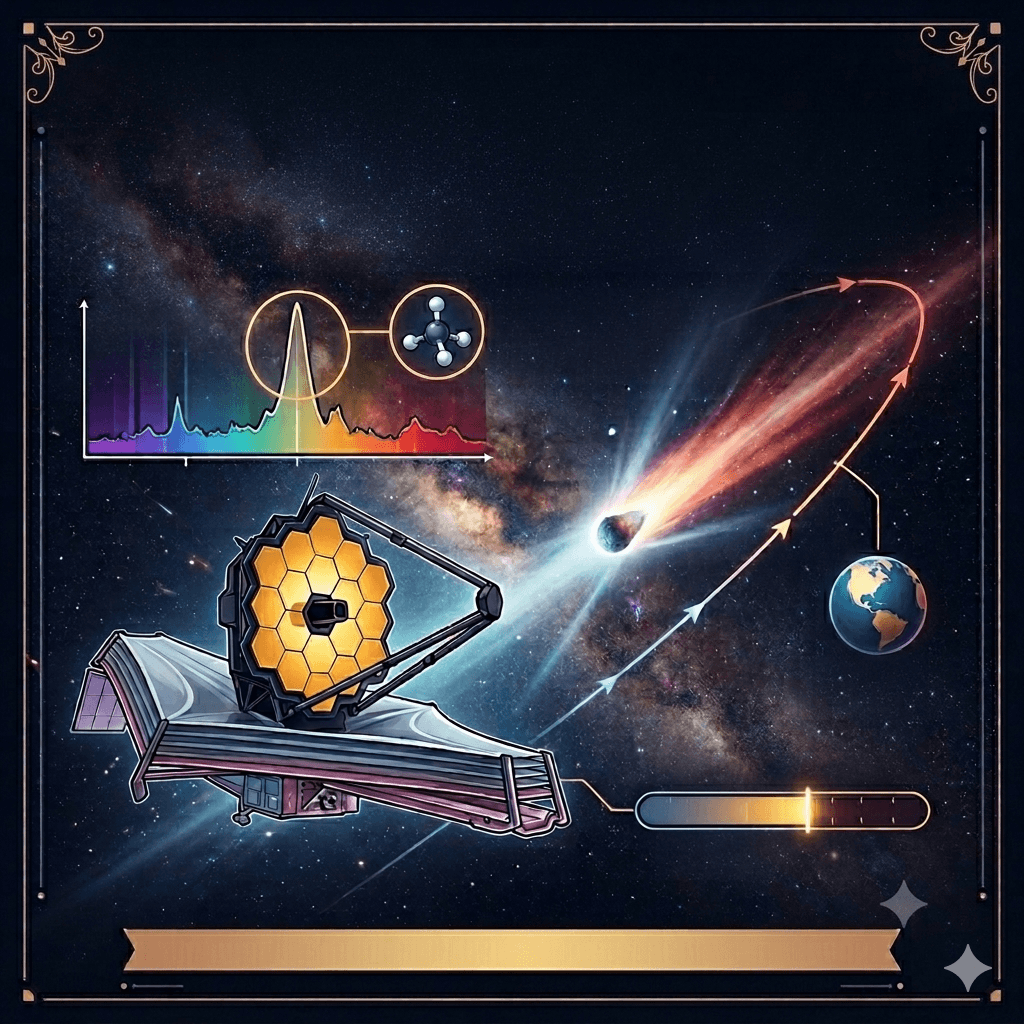

NASA’s James Webb Space Telescope has achieved another monumental first by directly detecting methane gas on the active interstellar comet 3I/ATLAS. Marking only the third confirmed interstellar object to traverse our solar system—following the famous footsteps of 1I/’Oumuamua and 2I/Borisov—this ancient wanderer is providing astronomers with an unprecedented look into the chemistry of an alien star system. The groundbreaking discovery, recently published in The Astrophysical Journal Letters, offers a pristine baseline to compare the building blocks of our own planetary backyard against those from distant corners of the Milky Way.
The historic observation was captured using Webb’s highly sensitive Mid-Infrared Instrument (MIRI) during two specific tracking windows as 3I/ATLAS hurried away from the Sun. The first deep-space scan occurred when the comet was roughly 205 million miles (329 million kilometers) from the Sun, followed by a secondary check-in nearly two weeks later at a distance of 236 million miles (379 million kilometers). By leveraging MIRI's specialized Medium Resolution Spectrometer, an integral field unit that collects a distinct chemical fingerprint at every individual pixel across the sky, scientists were able to map out a clear visual representation of the volatile gases enveloping the comet’s nucleus.
What makes the detection of methane ($\text{CH}_4$) on 3I/ATLAS so peculiar is its unexpected delay. Methane is an incredibly volatile substance, meaning it sublimates from a solid ice phase directly into a gas at very low temperatures and is typically among the first compounds to burn off. Because it went unnoticed during the comet's initial approach, astronomers deduce that the methane was deeply buried beneath the object's top crust layer. The chemical remained entirely shielded from space until the thermal energy from the comet’s close swing past the Sun finally penetrated deep enough into the icy subsurface to release the trapped gas.
A Stark Contrast to Our Solar System
Beyond the mere presence of methane, the sheer volume of the gas has left the astronomical community astonished. The ratio of methane to water vapor measured in the comet's coma is remarkably high, exhibiting a chemical profile that has almost no direct analogs among the homegrown comets originating in our solar system's Oort Cloud or Kuiper Belt. This distinct chemical signature serves as a glaring indicator that 3I/ATLAS was forged under vastly different environmental circumstances than the icy bodies orbiting our Sun.
Compounding the methane anomaly, Webb's data also confirmed that 3I/ATLAS is spectacularly rich in carbon dioxide ($\text{CO}_2$). The object continues to bleed out carbon dioxide at levels that drastically overshadow its water output—a stark inversion of typical solar system comet behaviors where water ice generally dominates the outgassing process. Because carbon dioxide and methane freeze at much lower temperatures than water, a body heavily saturated with both volatile compounds strongly implies an origin story rooted in a hyper-cold, chemically distinct region of interstellar space.
Watching a Wanderer Fall Dormant
As Webb continued to track the interstellar traveler into the deeper, freezing margins of our solar system, scientists witnessed a rapid, coordinated shutdown in its overall activity. As expected with declining solar radiation, the production of all detected gases dropped off sharply, but water vapor exhibited the most drastic plunge. Because water requires sustained thermal energy to sublimate compared to hyper-sensitive gases like methane or carbon dioxide, the fading sunlight effectively "shut off" the comet’s water production first, leaving the more volatile gasses to drift in a tighter, concentrated envelope near its 1.6-mile-wide nucleus.
Ultimately, these spectral blueprints captured by the James Webb Space Telescope are rewriting the rulebook on extrasolar planetesimals. Some orbital models even suggest that 3I/ATLAS could have originated within the Milky Way's ancient thick disk, making it potentially older than our own solar system. By peeling back the icy layers of this cosmic time capsule, humanity isn't just analyzing a passing rock; we are tasting the raw, primordial ingredients of an alien star system that formed billions of years ago.
NEVER MISS A THING!
Subscribe and get freshly baked articles. Join the community!
Join the newsletter to receive the latest updates in your inbox.