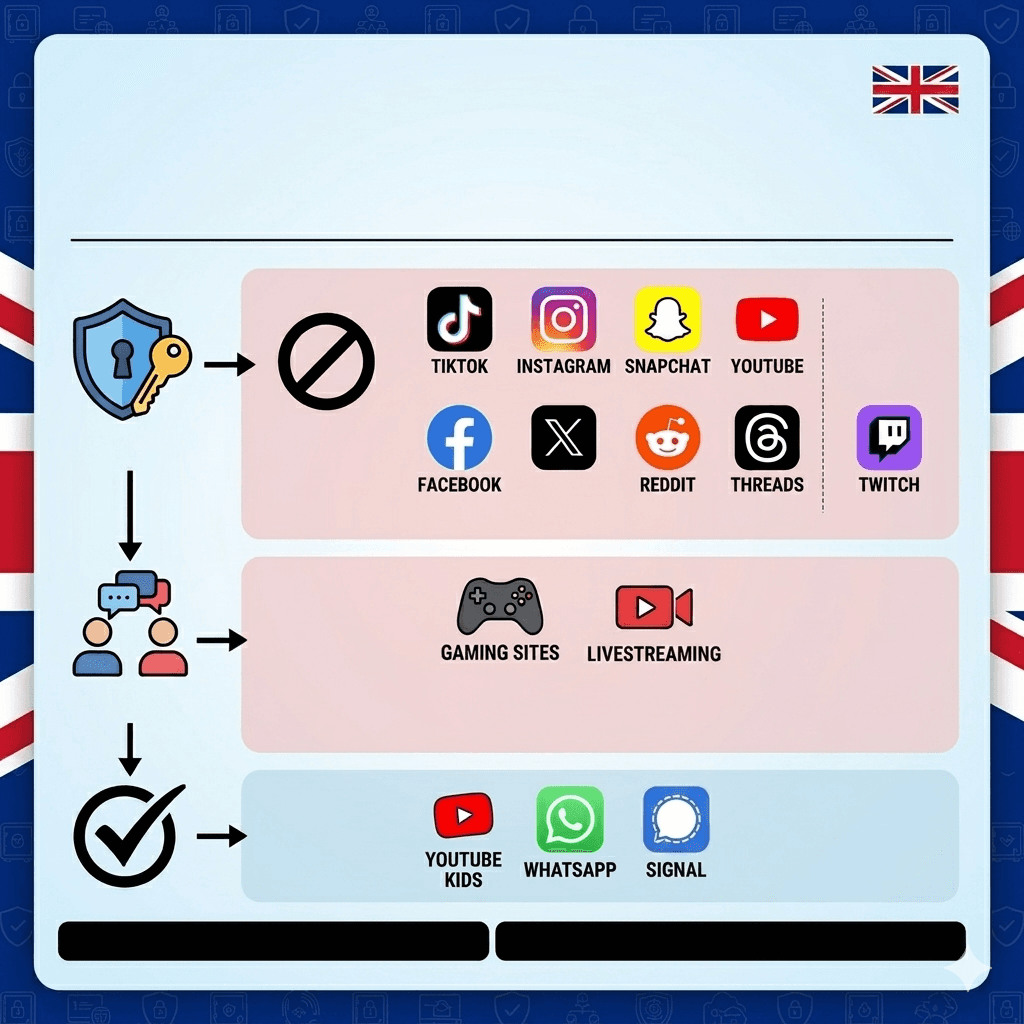

In a sweeping legislative move aimed at “giving children their childhood back,” UK Prime Minister Keir Starmer has announced a complete ban on social media for children under the age of 16. The historic policy shift, announced on June 15, 2026, marks one of the world’s toughest crackdowns on tech giants. Described by insiders as an "Australia-plus" model, the new legislation seeks to curb late-night scrolling, shield minors from addictive algorithms, and drastically reduce their exposure to online harm. The government expects to pass the regulations by December 2026, with the blanket ban fully coming into force by early 2027.
The primary target of this legislation is the ecosystem of major "user-to-user" platforms that leverage algorithmic feeds to drive engagement. Under the new definitions, under-16s will be blocked from accessing a long list of digital staples, including TikTok, Instagram, Snapchat, Facebook, X (formerly Twitter), Threads, and Reddit. Popular video and streaming services like YouTube and Twitch are also heavily hit under the mandate. Technology companies will bear the legal and financial responsibility for keeping children off these platforms, facing multi-million-dollar fines if they fail to enforce strict compliance.
However, the British government is drawing a clear line between public social networks and core utility services. Popular end-to-end messaging applications such as WhatsApp and Signal will remain exempt from the under-16 ban to ensure young people can still communicate securely with family and classmates. Educational resources and youth-centric alternatives, such as YouTube Kids, will also be permitted under the current guidelines, ensuring that children are not entirely cut off from safe, age-appropriate digital learning and media.
Going well beyond a simple social media block, Starmer’s "plus" framework directly targets features embedded within multiplayer gaming environments and live-streaming hubs. Under-16s will face world-leading restrictions on gaming services—such as Roblox—where features allowing direct, unvetted communication with strangers will be entirely deactivated. Furthermore, the legislation introduces a total ban on children under 16 broadcasting themselves via livestreaming. For older teenagers aged 16 and 17, these precise security features will be turned "on by default" to protect them from sudden digital vulnerabilities the moment they cross the age threshold.
The broader regulatory strategy also sets its sights on burgeoning artificial intelligence technologies and the late-night habits of older teenagers. The law will enforce a strict minimum age requirement of 18 for anyone trying to access AI-powered "romantic companion" or sexualized chatbots, eliminating the risk of minors engaging in inappropriate interactions with virtual tools. Additionally, the government is drafting proposals for under-18s that could introduce mandatory overnight curfews and automated breaks in infinite scrolling algorithms to combat screen addiction and sleep deprivation.
The policy follows a massive public consultation that pulled in over 116,000 responses, revealing an overwhelming desire for change from British households. More than 90% of responding parents backed the implementation of a minimum age restriction of 16, stating that the psychological and safety risks of open social media far outweigh the benefits. Prime Minister Starmer, a father of two teenagers himself, addressed public concerns by drawing a parallel to real-world protections: "We don't say: 'Oh, look, a teenager managed to get a drink somehow, so let's not bother banning drinks from children.' That would be utterly ridiculous!"
Despite high public favorability, the bold policy has drawn significant blowback from the technology industry and privacy advocates. Tech giants like Meta and Alphabet have warned that a blanket restriction could trigger an migration of youth toward riskier, entirely unregulated dark-web spaces. Digital privacy watchdogs have also expressed concern that forcing tech firms to verify ages will necessitate intrusive online identity checks or digital IDs for adult internet users as well. While Ofcom prepares an urgent study on effective age verification, the UK has made its stance explicitly clear: the era of tech giants self-regulating the youth is over.
NEVER MISS A THING!
Subscribe and get freshly baked articles. Join the community!
Join the newsletter to receive the latest updates in your inbox.