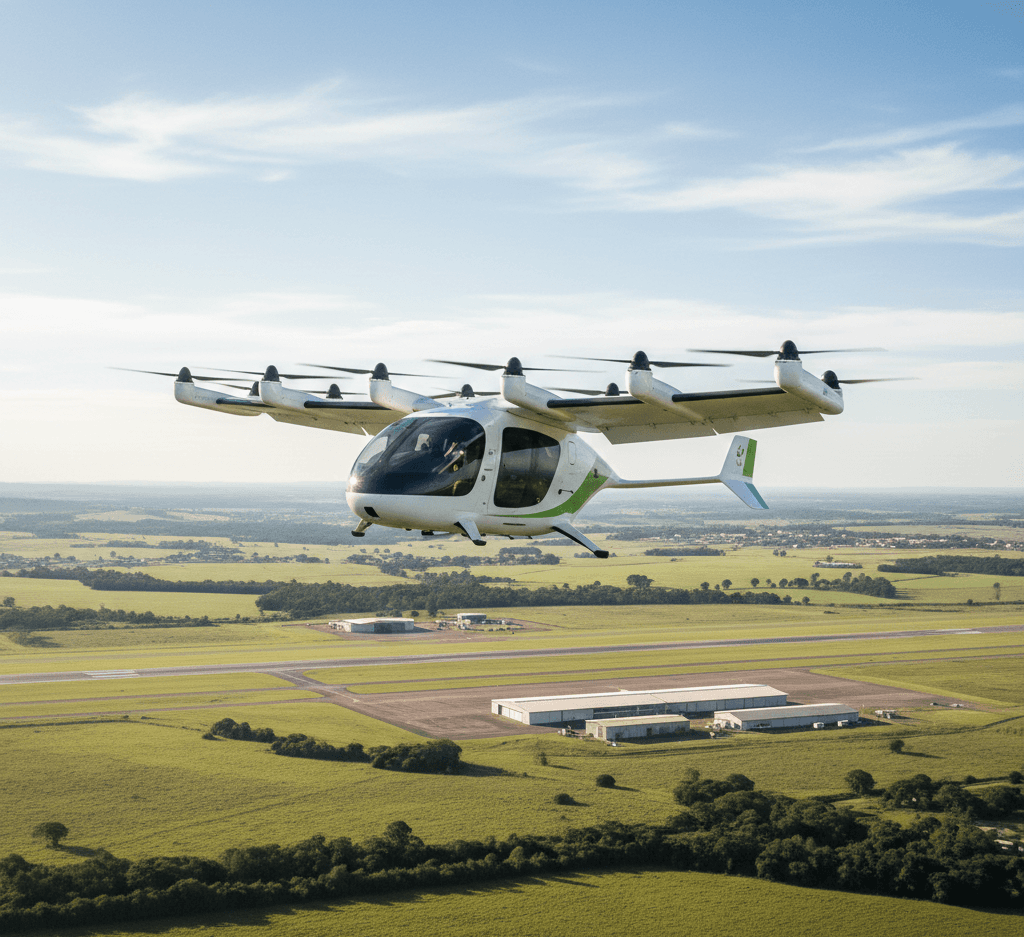

In a quiet but monumental moment for the future of transportation, the Brazilian sky witnessed a glimpse of the next century. Eve Air Mobility, the electric aircraft arm of aerospace giant Embraer, successfully completed the first flight of its full-scale electric vertical take-off and landing (eVTOL) prototype on December 19, 2025. This uncrewed test, conducted at Embraer’s facility in Gavião Peixoto, marks the official start of a rigorous flight test phase aimed at transforming urban commutes.
The maiden voyage consisted of a controlled hover, where the aircraft lifted vertically to an altitude of 40 feet, remained steady for approximately one minute, and landed with precision. While brief, the flight served as a critical validation of the aircraft’s fundamental architecture. Engineers confirmed the successful integration of the "Lift + Cruise" design, which uses eight dedicated rotors for vertical ascent and a rear-mounted "pusher" propeller for horizontal travel, ensuring a simpler and safer transition between flight modes.
A standout feature of the prototype is its fifth-generation digital "fly-by-wire" flight control system. Inherited from Embraer’s decades of expertise in commercial and defense aviation, this technology replaces traditional mechanical linkages with electronic interfaces. During the test, this system managed the aircraft's dynamic response and noise footprint perfectly, with Chief Technology Officer Luiz Valentini noting that the prototype behaved "exactly as predicted" by the company’s advanced simulators.
This success is more than just a technical achievement; it is a vital step toward the company’s goal of commercial service by 2027. Eve is now preparing to manufacture six conforming prototypes—units built exactly to the final production specifications—to undergo the hundreds of test flights required for certification. The company is working hand-in-hand with Brazil’s Civil Aviation Agency (ANAC) and the FAA to ensure the vehicle meets the world’s strictest safety standards.
The financial and industrial momentum behind Eve is equally impressive. Backed by a massive pre-order book of nearly 3,000 aircraft—the largest in the industry—Eve has secured significant support from international investors and Brazil’s National Bank for Economic and Social Development (BNDES). Recent financing packages, including a $40 million boost for propulsion integration, highlight the confidence that both the public and private sectors have in this "flying car" revolution.
Despite the celebration, the road to 2027 remains filled with challenges. The industry must still solve the "last mile" of urban mobility, which includes building "vertiports" for landing, upgrading electrical grids to handle high-speed charging, and gaining social acceptance for low-flying aerial traffic. However, Eve’s aircraft is designed to be 90% quieter than traditional helicopters, a key factor in making air taxis a welcome addition to congested cityscapes rather than a nuisance.
As the prototype moves into its next phase of testing—transitioning from a hover to full wingborne flight throughout 2026—Brazil is firmly positioning itself at the forefront of the sustainable aviation movement. By combining Embraer’s 56-year legacy with cutting-edge electric propulsion, Eve Air Mobility is not just testing a new vehicle; it is preparing to redefine how the world moves above the streets.
NEVER MISS A THING!
Subscribe and get freshly baked articles. Join the community!
Join the newsletter to receive the latest updates in your inbox.