
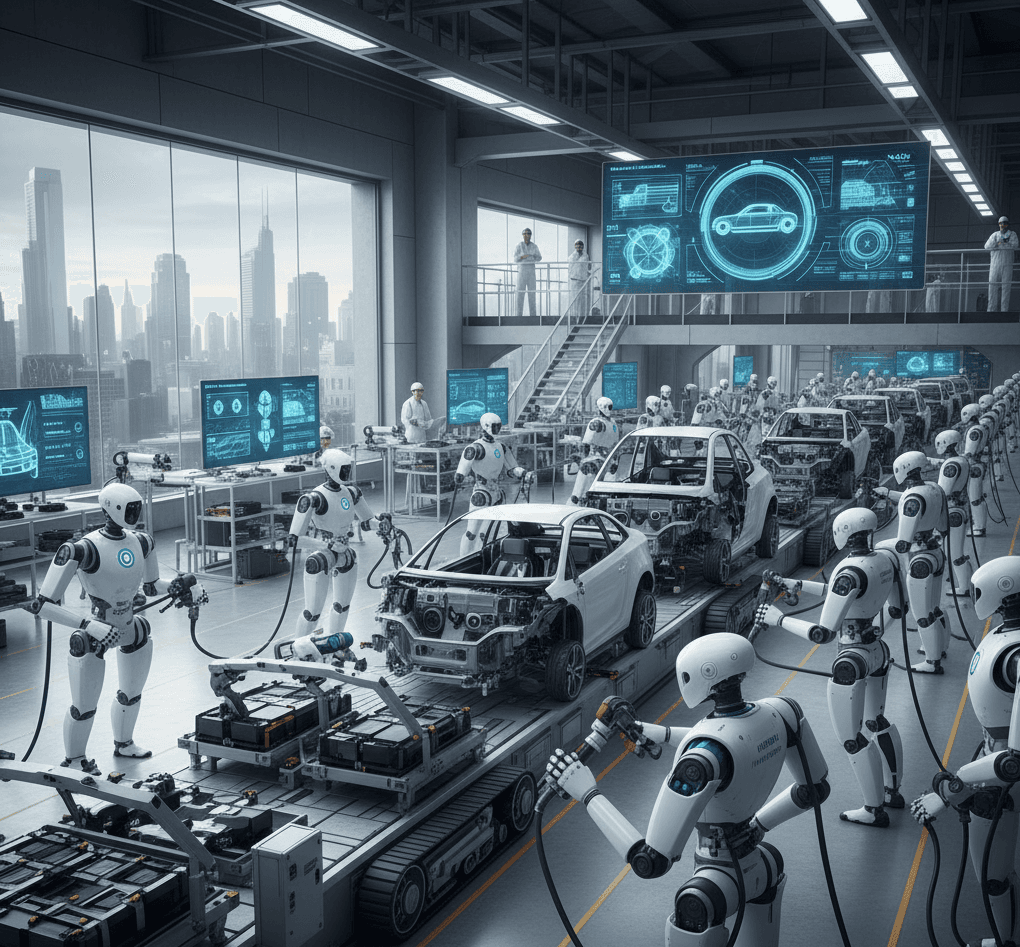

At a groundbreaking keynote at CES 2026, Hyundai Motor Group made a monumental announcement that signals a new era for manufacturing: the deployment of human-like robots in its factories. Moving beyond traditional industrial arms, Hyundai unveiled the production-ready Atlas Humanoid, developed in close collaboration with its subsidiary, Boston Dynamics. This strategic initiative, backed by a staggering $26 billion investment over the next four years, aims to integrate 30,000 of these advanced robots into Hyundai’s global manufacturing operations by 2028, starting with its cutting-edge Metaplants in Georgia and Singapore.
The new Atlas represents a quantum leap in robotic capabilities. Standing 5 feet, 9 inches tall and weighing 210 pounds, this bipedal robot boasts a redesigned, lighter frame with 360-degree range of motion in its joints, allowing for unprecedented agility and flexibility. Unlike previous generations, the production Atlas features advanced tactile-sensing hands capable of fine manipulation, distinguishing between materials and applying precise force. This enables the robots to perform intricate assembly tasks that were previously exclusive to human workers, from inserting delicate components to operating complex machinery.
The "brains" behind the Atlas Humanoid are equally impressive. Hyundai revealed a deep collaboration with Google DeepMind, integrating their latest breakthroughs in reinforcement learning and large language models (LLMs) to create truly "intelligent" robots. This allows Atlas to understand natural language commands, adapt to unforeseen obstacles, and even learn new tasks through observation. NVIDIA’s powerful DRIVE AGX Orin platform provides the on-board AI computing power, enabling real-time decision-making and precise motor control, even in dynamic factory environments.
A key focus of Atlas’s design is its robust payload capacity. Capable of lifting and maneuvering objects weighing up to 110 pounds (50 kg), these robots are slated to take over some of the most physically demanding and high-risk tasks on the assembly line. This includes welding, heavy component installation, and materials handling, freeing human workers from ergonomically challenging or dangerous roles. Hyundai emphasized that the goal is not merely automation, but "augmentation"—creating a safer, more efficient work environment where robots complement human skills.
The first major deployment is planned for Hyundai’s Metaplant America in Georgia, a sprawling facility designed from the ground up to integrate advanced robotics and AI. Here, Atlas robots will work alongside human counterparts in a hybrid manufacturing ecosystem. Hyundai’s long-term vision includes scaling production of Atlas to 30,000 units annually from its newly established robotics division in the US, positioning the company as a leader in the estimated $38 billion humanoid robot market by 2030.
Beyond just the automotive sector, Hyundai sees the Atlas Humanoid as a platform for various industries. While initial applications are centered on vehicle manufacturing, the versatile design and advanced AI capabilities suggest future roles in logistics, construction, and even disaster response. This modular approach to robotic development underscores Hyundai’s ambition to not just build cars, but to shape the future of industrial automation globally, offering "robotics as a service" to other enterprises.
Ultimately, Hyundai’s unveiling of the production-ready Atlas Humanoid at CES 2026 is a bold statement about the future of work. It represents a significant investment in a future where AI and advanced robotics enhance productivity, improve worker safety, and redefine the economics of manufacturing. As the first 30,000 units roll out over the next two years, the world will be watching to see how this human-like workforce transforms the factory floor and accelerates the next industrial revolution.
NEVER MISS A THING!
Subscribe and get freshly baked articles. Join the community!
Join the newsletter to receive the latest updates in your inbox.


