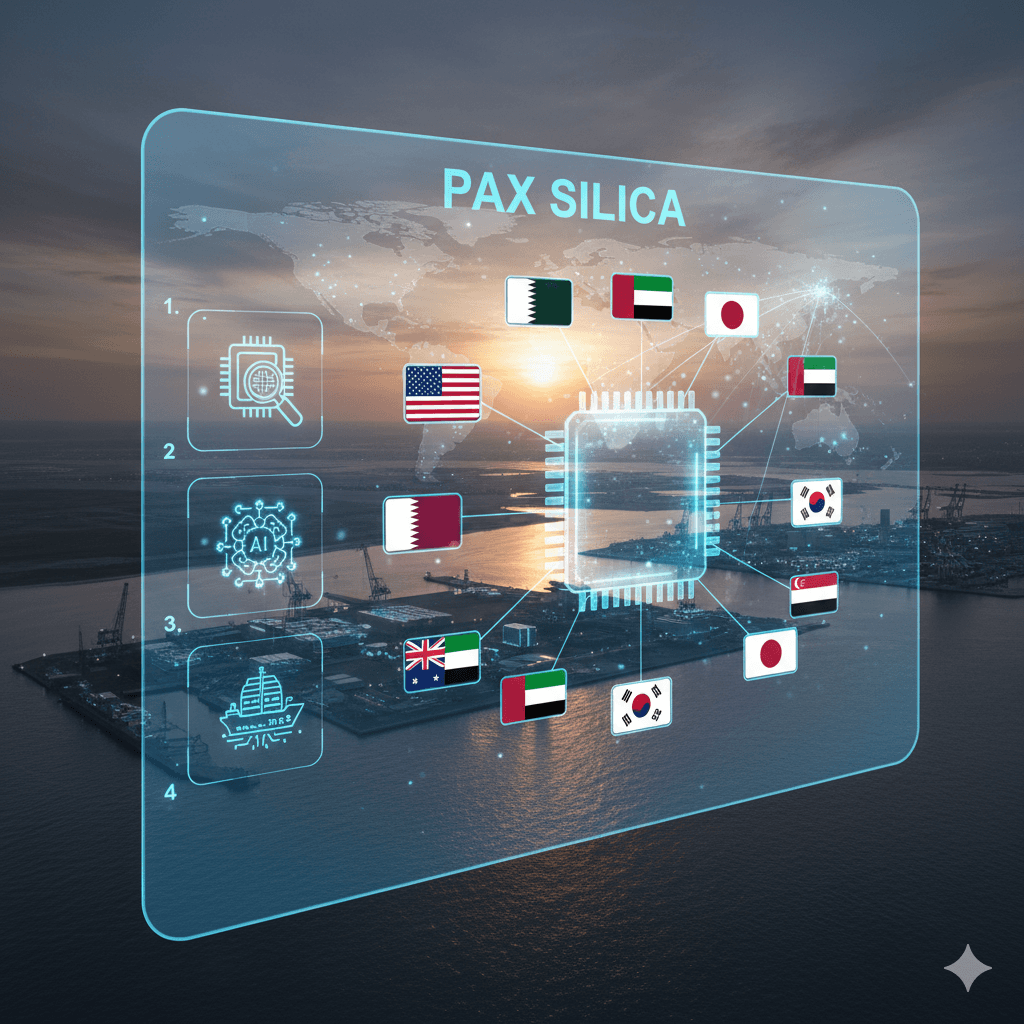

In a significant geopolitical and economic realignment, Qatar and the United Arab Emirates (UAE) are formally joining "Pax Silica," a pivotal U.S.-led initiative designed to bolster global supply chains for advanced technologies like semiconductors and Artificial Intelligence. The move, confirmed on January 11–12, 2026, marks a deepening of strategic ties between the United States and its key Gulf partners, aiming to create a robust "coalition of capabilities" against the backdrop of an increasingly competitive global tech landscape.
The "Pax Silica" program, rooted in the foundational "Silicon Declaration," goes beyond traditional military alliances, focusing instead on securing the entire technology stack. This includes critical raw materials, advanced manufacturing processes for semiconductors, and the digital infrastructure necessary for the AI revolution. For the U.S., the inclusion of Qatar and UAE is a critical step in establishing a resilient network of allies that can collectively reduce reliance on rival nations and safeguard the integrity of the global technology ecosystem.
For Qatar, expected to formally sign the declaration today, January 12, and the UAE, slated to join on January 15, this alliance represents a strategic pivot. Both nations have been aggressively pursuing economic diversification strategies, seeking to transition their economies away from hydrocarbon dependence towards knowledge-based, tech-driven futures. Joining Pax Silica offers them direct access to U.S. expertise, investment, and a secure pathway for integrating advanced technologies into their national development plans.
The Gulf states will join an existing elite consortium of nations that includes the U.S., Israel, Japan, South Korea, Singapore, Britain, and Australia. This expanded membership not only broadens the geographic scope of Pax Silica but also brings in new logistical capabilities and financial muscle. U.S. officials have described this as "Silicon Statecraft," a deliberate strategy to modernize existing trade routes, such as the India-Middle East-Europe Corridor, and to ensure that U.S. technology remains secure and dominant in the critical Middle Eastern region.
A key objective of this expanded alliance is to strategically counter the growing influence of China in the Middle East's technology sector. By offering a secure and reliable alternative for sourcing cutting-edge components and developing AI infrastructure, Pax Silica aims to prevent the region from becoming overly dependent on technologies from geopolitical rivals. This collaboration is expected to include joint ventures in research and development, shared intellectual property protections, and coordinated efforts to prevent technology transfer to adversarial states.
The implications for the global supply chain are profound. With the addition of Qatar and the UAE, Pax Silica gains partners with significant investment capabilities and strategic logistical positions. This allows for greater coordination in securing the supply of critical minerals essential for chip manufacturing and for establishing secure data centers. The goal is to fortify the entire pipeline—from raw material extraction and processing to chip fabrication and the deployment of AI systems—making it more resistant to disruptions, whether from natural disasters or geopolitical tensions.
Ultimately, the joining of Qatar and the UAE into Pax Silica solidifies a new axis of technological cooperation. It underscores a shared understanding that economic prosperity and national security in the 21st century are inextricably linked to technological leadership and supply chain resilience. As the world navigates a complex era of digital transformation, this U.S.-led alliance is poised to play a crucial role in shaping the future of global technology governance and ensuring a secure, diversified, and innovative supply chain for critical advancements.
NEVER MISS A THING!
Subscribe and get freshly baked articles. Join the community!
Join the newsletter to receive the latest updates in your inbox.