
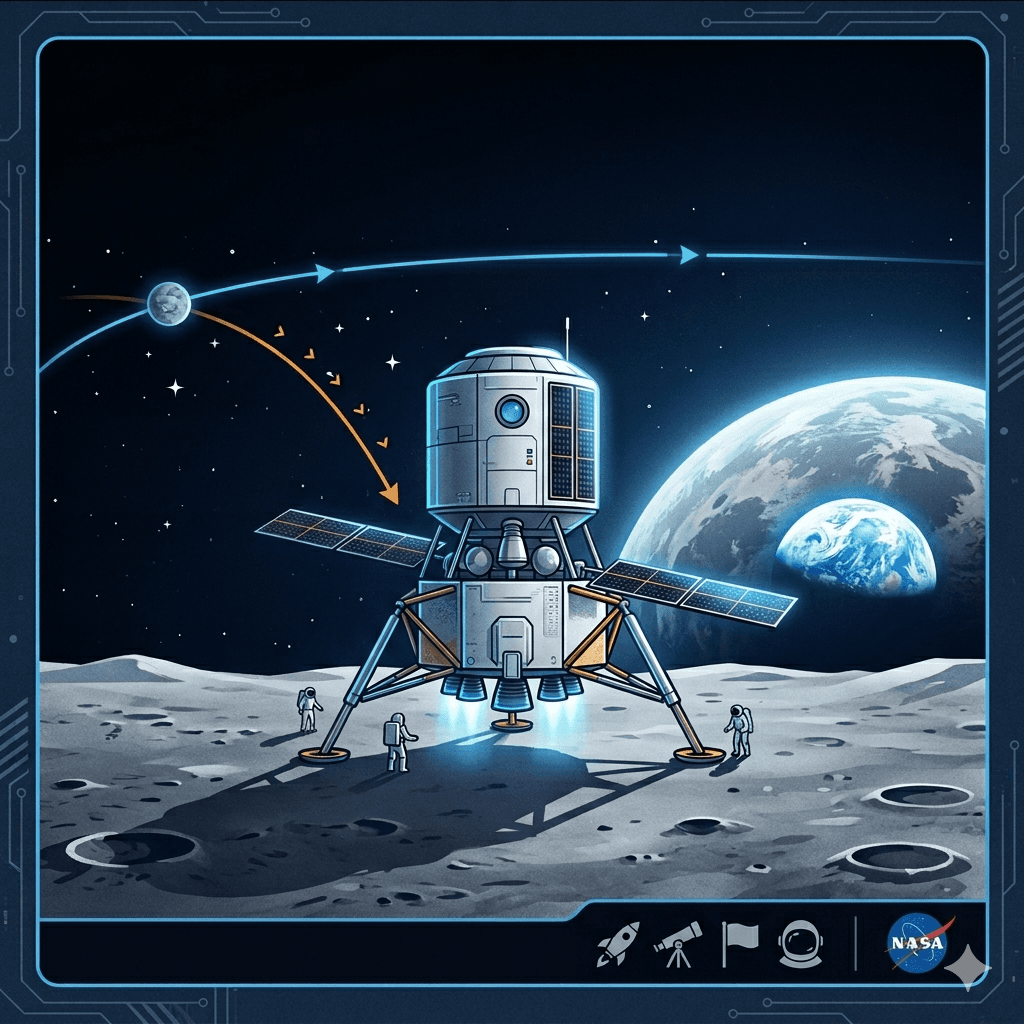

Humanity's ambitious journey back to the lunar surface is undergoing a profound structural evolution. Following the historic triumph of the crewed Artemis II mission, which successfully orbited the Moon and returned to Earth, NASA is pivoting its strategy toward long-term sustainability. The initial architectures designed for brief, Apollo-like stays are giving way to robust, multi-mission blueprints. Freshly revised operational approaches detailed by space agency officials outline a massive push toward structural maturity, striking a balance between commercial ingenuity and aggressive risk reduction.
Central to this structural shift is a fundamental restructuring of the near-term Artemis flight manifest. In a notable strategic pivot, NASA re-scoped the upcoming Artemis III mission to serve as a low Earth orbit (LEO) test flight rather than an immediate crewed lunar landing. Scheduled for late 2027, Artemis III will fly a four-astronaut crew aboard the Orion spacecraft specifically to test rendezvous, docking, and life-support operations alongside commercial lander pathfinders. This critical interim flight allows engineers to thoroughly vet complex multi-spacecraft operations closer to home, drastically lowering risks before astronauts attempt a historical touchdown on the lunar surface during Artemis IV.
The newly updated blueprints for the Human Landing System (HLS) rely heavily on a redundant, competitive dual-provider strategy. Both SpaceX, with its crewed Starship HLS variant, and Blue Origin, utilizing its massive Blue Moon Mark 2 design, are actively modifying their lander hardware to meet strict new performance baselines. Despite recent development obstacles—including a high-profile launchpad anomaly that impacted Blue Origin's heavy-lift capabilities—both commercial aerospace giants are collaborating closely with NASA to refine their vehicle architectures. This multi-tiered strategy ensures that the United States maintains two independent pathways to the lunar terrain, guaranteeing programmatic resilience.
Technologically, the revised lunar lander plans emphasize unprecedented vehicle scale and operational endurance. Unlike the historic Apollo Lunar Modules that maxed out at three days on the surface with two astronauts, the modern Artemis landers are scaled to sustain a full crew of four for a minimum of one week, with long-term goals extending past a month. This leap in capability is made possible by modular habitat segments, highly efficient thermal management systems, and significantly increased payload capacities capable of ferrying advanced rovers and scientific arrays directly to the rugged lunar South Pole.
Furthermore, sustainability sits at the core of these revised engineering plans, transitioning the hardware from costly single-use vehicles to reusable infrastructure. Rather than discarding massive propulsion elements into space after a single landing, the next-generation landers are being framed around a framework of refuelable architectures. Orbiting propellant tankers and specialized fuel depots will eventually replenish the landers in space, laying down a cost-effective, continuous pipeline for transportation between lunar orbit and the surface.
This evolving architecture is heavily geared toward establishing a permanent, operational foothold on the Moon. By standardizing automated hazard-detection and precision-landing systems—pioneered by robotic Mars explorers—the revised landers can safely navigate the harsh lighting conditions and extreme topography of the lunar South Pole. Over time, these landers will transition from carrying survival supplies from Earth to supporting the harvesting of local resources, such as water ice and volatile minerals, directly from deep lunar craters.
The revised roadmap paves a clear path for an intense schedule of deep-space exploration. Following the late-2027 low Earth orbit trials of Artemis III, the focus turns directly to Artemis IV in early 2028, which is slated to achieve the first crewed lunar landing in over five decades. From Artemis V onward, scheduled for late 2028 and beyond, the lander infrastructure will shift from a tool of exploration to a baseline of construction, actively ferrying the heavy machinery, habitat expansions, and science labs required to establish a permanent Moon base.
NEVER MISS A THING!
Subscribe and get freshly baked articles. Join the community!
Join the newsletter to receive the latest updates in your inbox.


