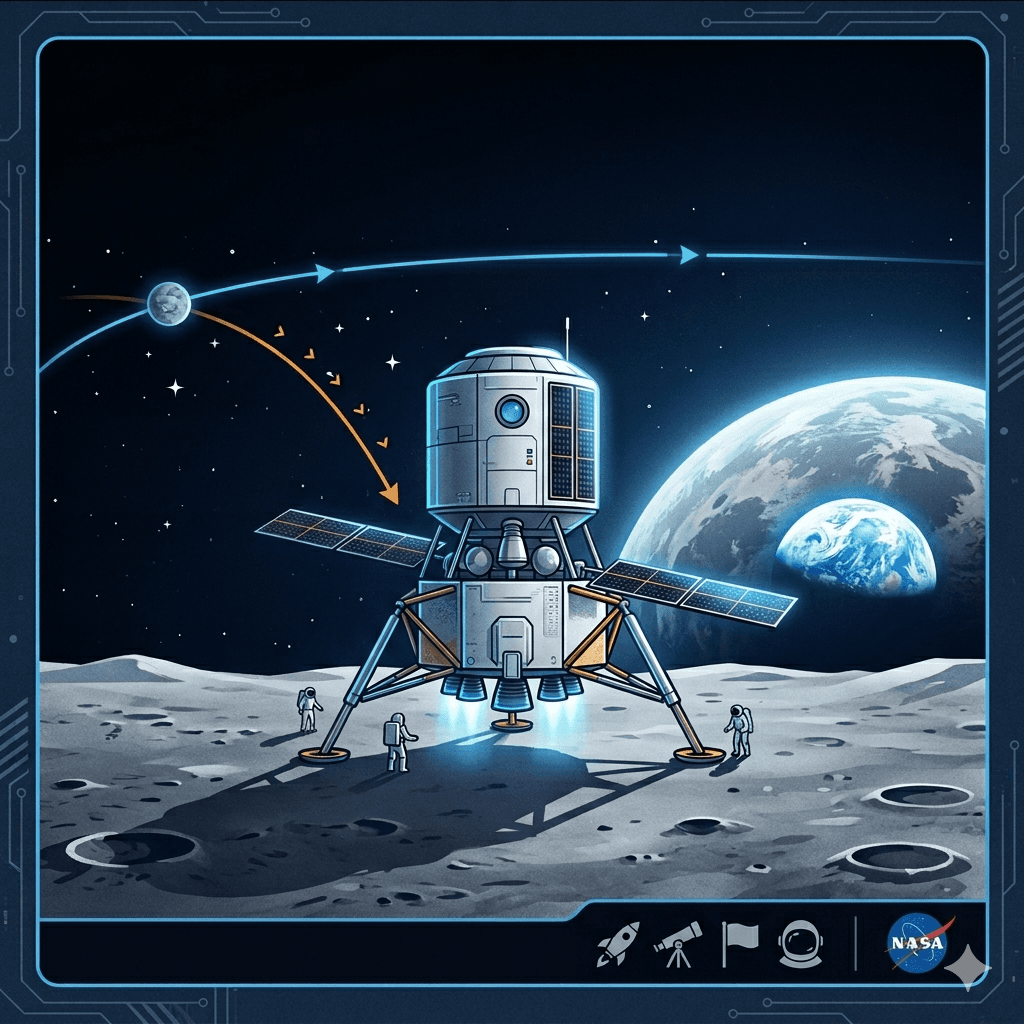
The race to build artificial intelligence infrastructure has officially transcended Earth's atmosphere. Faced with severe power constraints, grid saturation, and real estate bottlenecks on the ground, a pioneering wave of space startups—including Orbital, Starcloud, and Lonestar Data Holdings—is actively working to deploy AI data centers into Low Earth Orbit (LEO). Backed by shifting industry dynamics, including high-profile pushes from tech giants, the concept of orbital compute is moving rapidly from science fiction to an active infrastructure frontier. However, as these companies attempt to scale, they are colliding with a very earthly prerequisite for massive infrastructure deployment: the necessity of commercial insurance.
The logic driving data centers into space is fundamentally tied to energy and thermal management. On Earth, training and running next-generation AI models demands unprecedented amounts of electricity, frequently overloading local power grids. In orbit, particularly in sun-synchronous trajectories, data center satellites can harness continuous, uninterrupted solar energy up to five times denser than what is available on the ground. Furthermore, the vacuum of space provides an infinite heat sink, allowing for highly efficient, passive radiative cooling that bypasses the resource-heavy liquid cooling loops required by terrestrial facilities.
Despite these orbital advantages, space startups are facing an immediate financial hurdle. To progress from early-stage venture-backed prototypes to full-scale commercial constellations, these companies must transition from venture capital to large-scale debt financing. Institutional lenders and traditional credit markets rarely fund unmitigated, multi-million-dollar hardware deployments without a safety net. Consequently, space companies have initiated preliminary discussions with major global insurance brokers and underwriters to figure out how to structure risk coverage for extraterrestrial digital infrastructure.
The global space insurance market, which currently collects roughly $500 million in annual premiums, is well-versed in underwriting traditional space hazards. Underwriters routinely cover launch failures, satellite malfunctions, solar weather, and the ever-growing threat of orbital debris. Yet, an AI data center introduces entirely foreign variables to the risk ledger. Unlike standard communications satellites, orbital data centers are packed with densely clustered, high-performance GPUs. Insurers are currently tasked with figuring out how to model the degradation of these hyper-advanced, delicate processors when exposed to sustained cosmic radiation over multi-year lifecycles.
Because orbital AI data infrastructure is a completely novel asset class, underwriters lack historical data to accurately calculate premiums. Current industry briefings—such as a recent presentation hosted by Lonestar Data Holdings for roughly 25 insurers at Lloyd's of London—are less focused on final pricing and more on whether these risks can be modeled at all. Actuaries must evaluate complex hardware issues like "bit flips" caused by radiation, the valuation of rapidly depreciating silicon in space, and the structural integrity of autonomous systems designed to process data closer to where satellite imagery is generated.
For the insurance sector, the demand for orbital data center policies remains minimal but highly strategic. Leading brokerage firms like Marsh note a visible rise in digital infrastructure companies looking to the insurance community for early support. While experimental test flights, such as Orbital’s upcoming 2027 demonstration mission, are largely self-funded or venture-backed, the true test for insurers will arrive over the next few years. Insurance capacity will need to expand dramatically before tech firms can reliably secure the debt capital required to establish permanent, gigawatt-scale computing clusters in the stars.
The dialogues taking place between space tech founders and London underwriters underscore a broader reality: the future of AI is explicitly intertwined with the future of logistics, spaceflight, and finance. If the space insurance market can successfully adapt its models to cover orbital silicon, it will unlock the capital necessary to alleviate Earth’s energy crisis. Until then, the dream of infinite, space-based AI compute remains tethered to a very practical, terrestrial question of who bears the cost when hardware fails in the void.
NEVER MISS A THING!
Subscribe and get freshly baked articles. Join the community!
Join the newsletter to receive the latest updates in your inbox.