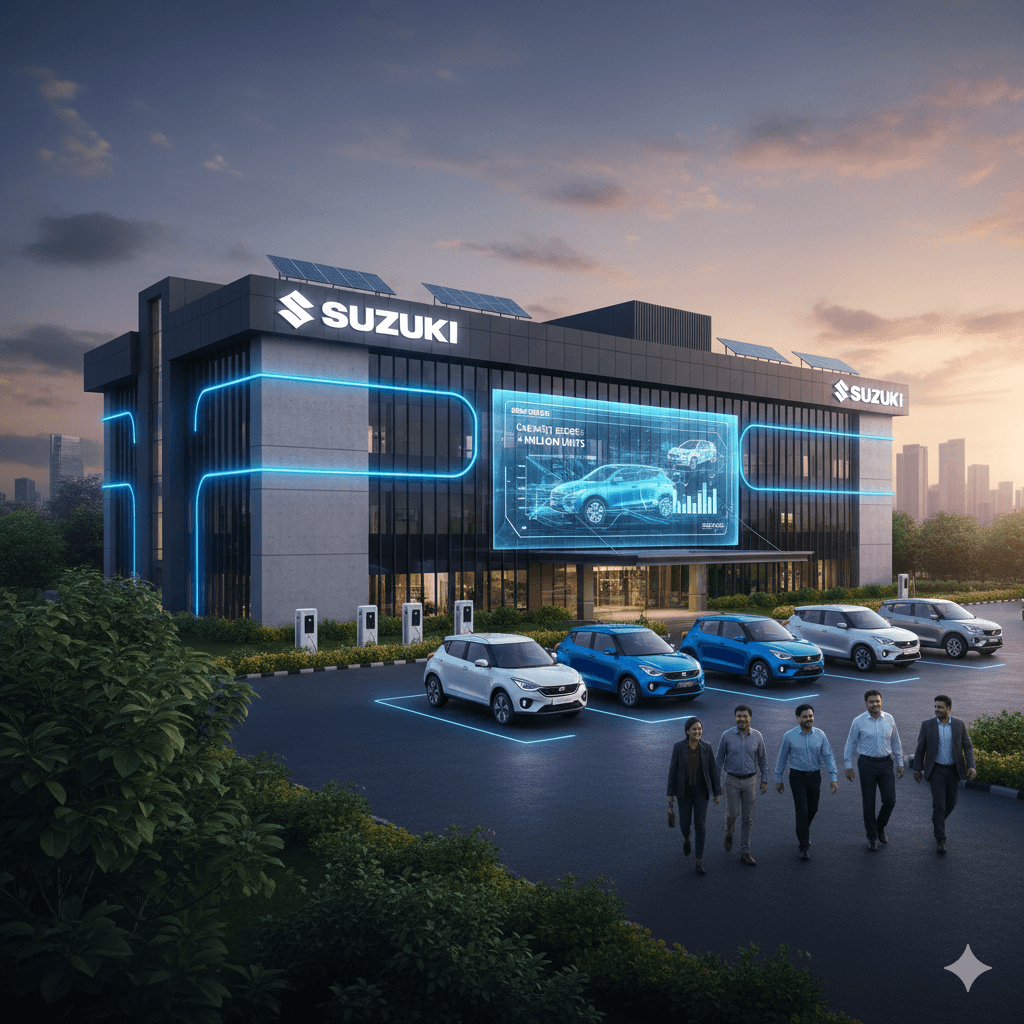

Maruti Suzuki India Limited (MSIL) has officially taken the first major step toward doubling its manufacturing footprint, announcing board approval for a massive land acquisition in Gujarat. On January 12, 2026, the country's largest carmaker greenlit an investment of ₹4,960 crore to secure land at the Khoraj Industrial Estate. This new site is earmarked for a greenfield manufacturing facility that will eventually add 1 million units of annual production capacity, supporting the company's ambitious goal of producing 4 million vehicles yearly by 2031.
The move comes at a critical time for the automaker, as its existing production lines across Haryana and Gujarat have reached a state of "full utilization." With an installed capacity of approximately 2.4 million units—rising to a technical capability of 2.6 million units following the recent merger of Suzuki Motor Gujarat—Maruti Suzuki has had little to no "breathing room" to address surging domestic demand. By locking in the Khoraj site, the company is securing the necessary headroom to avoid supply-side bottlenecks that could otherwise lead to lost market share.
The Khoraj plant is set to become Maruti Suzuki’s fifth major manufacturing hub in India, following its established bases in Gurugram, Manesar, Hansalpur, and the recently commissioned site at Kharkhoda. While the specific timeline for the plant's full rollout will be finalized in subsequent phases, initial operations are expected to commence by the 2028–29 financial year. The project will be financed through a strategic mix of the company’s internal cash reserves and external borrowings, reflecting a balanced approach to large-scale capital expenditure.
A primary driver for this 1-million unit boost is the company’s aggressive export strategy. Maruti Suzuki has emerged as India’s top passenger vehicle exporter for five consecutive years, and it now aims to ship nearly 800,000 units annually to global markets by the end of the decade. The Gujarat location offers a distinct logistical advantage, providing shorter transit times to the Mundra and Pipavav ports, which serve as the primary gateways for Maruti’s growing customer base in Africa, Latin America, and Southeast Asia.
Beyond internal combustion engines, the new facility is expected to play a vital role in Maruti Suzuki’s electrification roadmap. As the company prepares for the commercial launch of its first high-profile electric SUV, the e-Vitara, in 2026, the additional capacity will allow for flexible manufacturing lines. These lines are designed to pivot between petrol, CNG, hybrid, and battery-electric powertrains (BEVs) based on market demand, ensuring the company remains agile as India’s energy transition accelerates.
The investment also aligns with the broader "Make in India" initiative and the government’s Production Linked Incentive (PLI) schemes. By expanding its presence in Gujarat, Maruti Suzuki is further densifying the state’s burgeoning automotive ecosystem, which now rivals traditional hubs in South India. This expansion is expected to trigger a secondary wave of investment from auto-component vendors, potentially creating thousands of new jobs in the Gandhinagar and Ahmedabad districts over the next four years.
As the industry moves into 2026, Maruti Suzuki’s "Vision 3.0" is coming into sharp focus. By aiming for a 4-million unit capacity, the company is betting on a future where India is not just a massive consumer market, but a global manufacturing powerhouse. For Indian car buyers, this expansion promises shorter waiting periods and a wider array of high-tech vehicles, cementing Maruti Suzuki's position as the dominant architect of India’s automotive future for the next century.
NEVER MISS A THING!
Subscribe and get freshly baked articles. Join the community!
Join the newsletter to receive the latest updates in your inbox.