
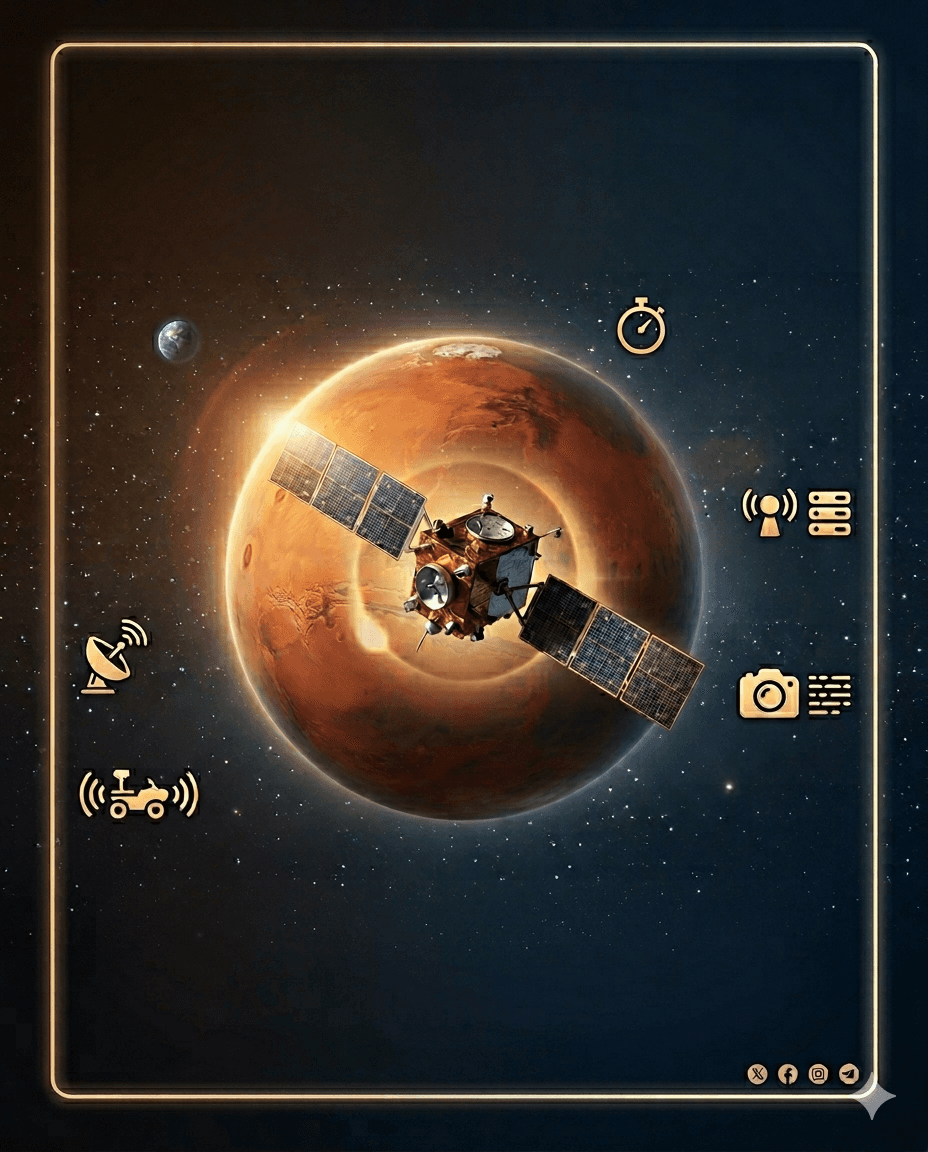

NASA has officially announced the end of the mission for its long-operating MAVEN (Mars Atmosphere and Volatile Evolution) spacecraft, concluding over a decade of groundbreaking science at the Red Planet. The decision comes after six months of radio silence from the robotic probe, which first went missing in late 2025. Following exhaustive efforts to reconnect and a thorough independent review, space agency officials formally declared the spacecraft unrecoverable.
The silence began on December 6, 2025, during what was expected to be a routine orbital pass behind Mars. While all subsystems were operating normally prior to entering the planet's shadow, MAVEN failed to "phone home" once it reemerged. A brief fragment of telemetry recovered by NASA's Deep Space Network later revealed that the spacecraft had unexpectedly entered safe mode and was trapped in a rapid, uncontrollable spin. An anomaly review board concluded that this excessive rotation completely drained the onboard batteries, permanently disabling the communication systems.
For the mission team, the formal conclusion brings a profound sense of grief mixed with immense celebration. "The team really did experience the loss of a loved one with the end of the mission here," remarked NASA project manager Mike Moreau during an agency press conference. Shannon Curry, MAVEN’s principal investigator at the University of Colorado Boulder, praised the robotic explorer as the "Best. Mars. Mission. Ever.", highlighting how deeply attached the engineers and planetary scientists had become to the resilient orbiter over its 11 years of service.
Launched in November 2013, MAVEN arrived in Martian orbit in September 2014 with a primary directive to last just one Earth year. Instead, the $582 million spacecraft survived for more than a decade, fundamentally reshaping humanity's understanding of planetary weather and evolution. It was the first probe ever equipped specifically to study Mars's upper atmosphere and ionosphere, exploring how the harsh solar wind relentlessly interacts with the planet.
Throughout its highly extended lifespan, MAVEN answered a fundamental celestial mystery: where did Mars's water and atmosphere go? The probe provided the first direct evidence of atmospheric "sputtering"—a process where solar particles actively strip away gases into deep space. It revealed that global dust storms on Mars loft water molecules high into the sky where they are rapidly lost, proving how the Red Planet transformed from a warm, wet, potentially habitable world eons ago into the arid desert it is today.
Beyond its atmospheric breakthroughs, MAVEN acted as an invaluable infrastructure hub in deep space. It served as a critical communications relay, bouncing data between Earth and NASA's surface robots, including the Curiosity and Perseverance rovers. Fortunately, NASA officials confirmed that four other active orbiters surrounding Mars—two American and two European satellites—will smoothly pick up the relay workload, ensuring that active surface operations face no scientific data loss.
Though the silent, solar-powered explorer is now a ghost ship, it won't disappear anytime soon. Experts project that MAVEN will remain locked in its silent Martian orbit for another 50 to 100 years before gravity finally draws it down to crash onto the rusty surface below. Until then, its rich, eleven-year archive of atmospheric data will be preserved, promising to fuel new cosmic discoveries and protect future human astronauts for decades to come.
NEVER MISS A THING!
Subscribe and get freshly baked articles. Join the community!
Join the newsletter to receive the latest updates in your inbox.


