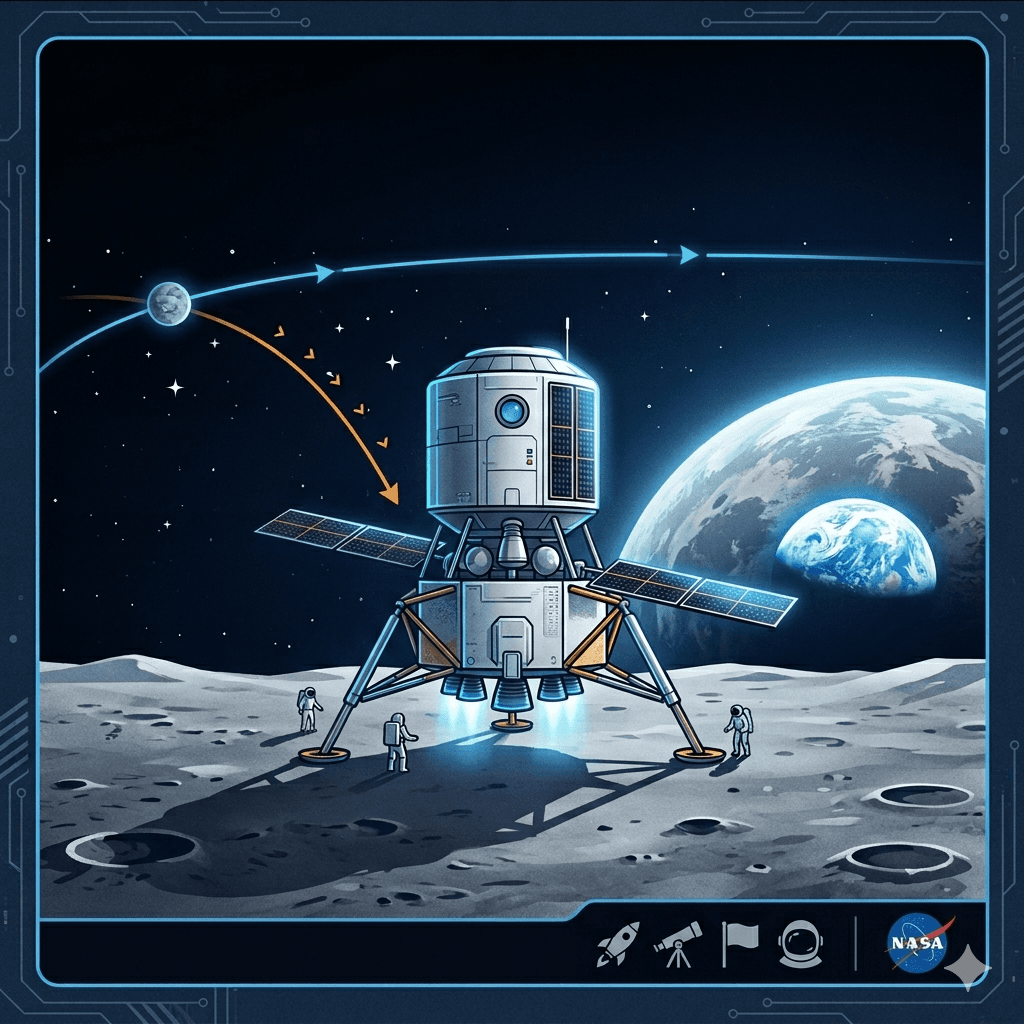
In an ambitious twist for the future of space exploration, NASA has revealed that it is exploring a creative new way to accelerate its lunar base initiatives. During a recent Moon Base program update, agency officials announced a proposal to take a massive, car-sized Mars test rover—originally built to never leave Earth—and launch it to the Moon's rugged south pole. If approved, this unexpected mission would give a second life to a powerhouse piece of hardware that has spent years sitting in a Southern California laboratory.
The robotic explorer at the center of this plan is an exact, full-scale engineering model of the Perseverance and Curiosity rovers currently operating millions of miles away on the Red Planet. Affectionately nicknamed "Promise" (Polar Rover for Observation, Mapping, and In-Situ Exploration), the 1-ton vehicle has spent its existence at NASA’s Jet Propulsion Laboratory (JPL) serving as an Earth-bound twin. Up until now, engineers have used Promise in the facility's "Mars Yard" to stress-test software patches, practice complex maneuvers, and troubleshoot hardware glitches before sending instructions out into the cosmos.
With both active Mars rovers continuing to operate smoothly on their own, space agency leadership believes the time is right to send Promise on its own standalone mission. NASA Administrator Jared Isaacman expressed immense enthusiasm for the idea, famously invoking Yoda's classic line from Star Wars, "There is another," before explaining that the hardware is already built and ready. Instead of letting the highly advanced machine gather dust as a permanent testbed, the agency wants to leverage its flight-proven architecture to jumpstart deep space exploration closer to home.
The primary advantage of deploying a modified Mars rover to the lunar surface boils down to one crucial feature: its power source. Unlike typical lunar rovers, including NASA’s highly anticipated solar-powered VIPER rover, Promise is built to run on a Multi-Mission Radioisotope Thermoelectric Generator (MMRTG). This nuclear generator converts heat from the natural decay of Plutonium-238 into electricity. Because NASA already has an available MMRTG on hand with a supply of plutonium that is slowly decaying away, using it on the lunar surface represents a brilliant, cost-effective allocation of existing resources.
This nuclear capability is precisely what makes Promise uniquely qualified for the unforgiving environment of the Moon’s south pole. While solar-powered vehicles are strictly bound by the availability of sunlight—meaning they cannot survive the brutal, fortnight-long lunar nights or venture deep into permanent shadows—a nuclear-powered rover can operate indefinitely in total darkness. This allows the heavy-duty vehicle to plunge directly into the pitch-black, frigid craters where scientists believe vast deposits of water ice are waiting to be discovered and mapped.
Transitioning a vehicle designed for Mars to the lunar surface will, however, require some clever engineering adjustments. While JPL scientists have confirmed that the rover’s core chassis and driving systems can be adapted to navigate the fine, abrasive lunar regolith, its scientific instruments will need to be refitted to focus on lunar geology and resource hunting rather than searching for past microbial life on Mars. Furthermore, because of the rover's massive 1-ton weight, it will bypass standard smaller landing crafts entirely; NASA is eyeing commercial giants like Blue Origin's Blue Moon lander or SpaceX's Starship to deliver the heavy vehicle safely to the ground.
Ultimately, sending the Promise rover to the Moon reflects a broader, urgent strategic shift to solidify an American presence on the lunar surface. Carlos García-Galán, NASA's Moon Base program manager, emphasized that overcoming the lunar night is one of the ultimate hurdles before astronauts can establish a permanent outpost. By deploying an advanced, long-lasting scout to map out terrain and resources without the limitations of solar dependency, NASA can dramatically accelerate its timeline to build a sustainable home on the Moon.
NEVER MISS A THING!
Subscribe and get freshly baked articles. Join the community!
Join the newsletter to receive the latest updates in your inbox.