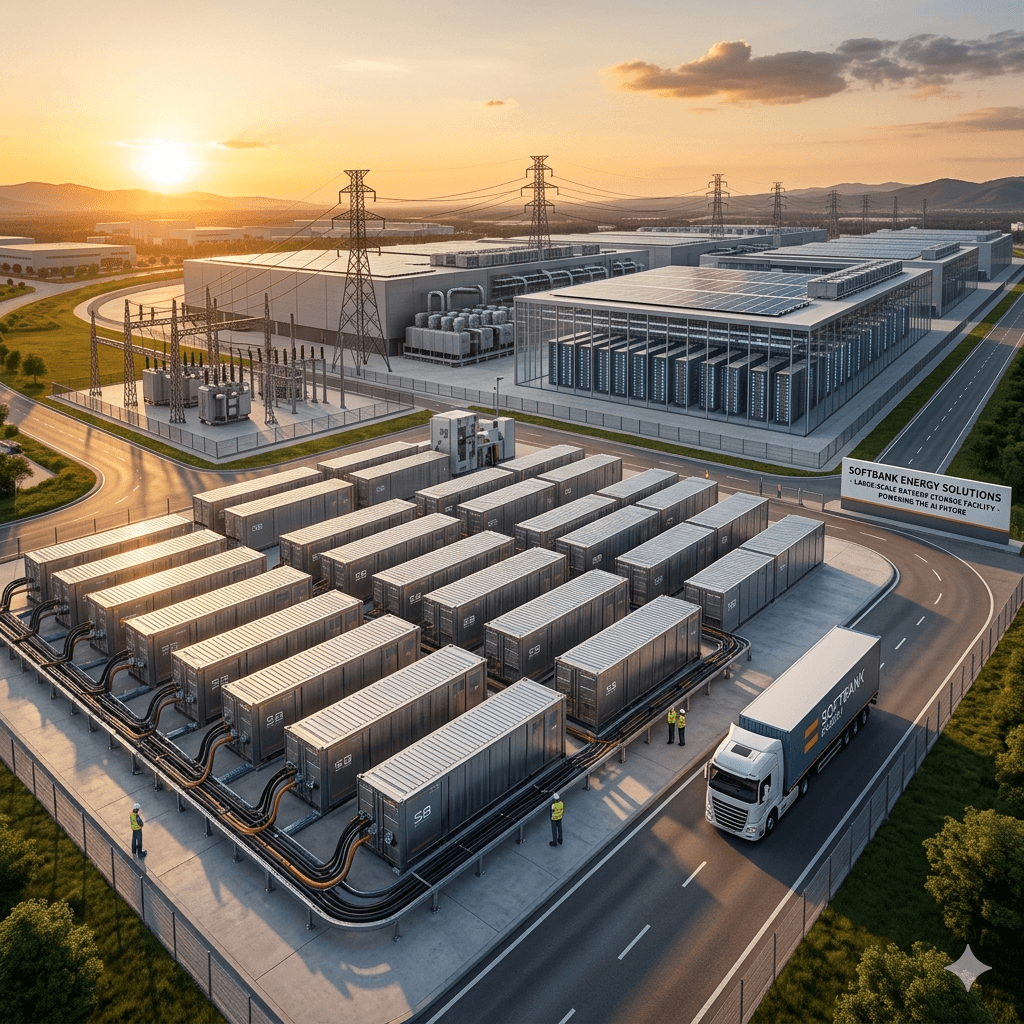

SoftBank Corp. has announced a bold plan to transform part of a former liquid-crystal display (LCD) plant in Sakai, Osaka, into one of Japan’s largest production lines for large-scale batteries. This strategic move is designed to address the surging electricity demands of artificial intelligence (AI) services. By integrating energy production directly with its AI data centers, SoftBank aims to create a vertically integrated "stack" that ensures operational stability for the massive, power-hungry workloads typical of modern AI systems.
The initiative involves the establishment of two specialized hubs: the AX Factory, which will focus on AI data center operations and hardware manufacturing, and the GX Factory, dedicated to producing next-generation batteries and solar panels. SoftBank is partnering with South Korea’s Cosmos Lab and DeltaX to enable mass production, leveraging their expertise in zinc-halogen technology and high-energy-density designs. The goal is to begin manufacturing at a scale of one gigawatt-hour (GWh) per year by fiscal year 2027, with the potential to expand to several GWh.
Founder Masayoshi Son has shifted the company's focus from telecommunications toward becoming a core player in AI infrastructure. The batteries are not only intended for SoftBank's own use but will also be supplied to third parties for grid applications, factories, and residential use. Over the medium term, the company plans to expand these energy solutions into global markets. SoftBank expects this new battery business to generate over 100 billion yen (approximately $644 million) in annual revenue by fiscal 2030.
To maintain a competitive edge against dominant Chinese battery manufacturers, SoftBank is exploring advanced cell technologies. While lithium iron phosphate (LFP) remains a standard for its safety and cost-effectiveness, the company is prioritizing innovative alternatives like aqueous zinc-halogen batteries. These cells, developed with Cosmos Lab, aim for energy efficiency equal to or greater than lithium-ion batteries while offering enhanced safety.
The Sakai facility itself is a massive undertaking, spanning roughly 840,000 square meters. A portion of this site will house an AI data center that could eventually scale to over 400 megawatts of capacity, with the first phase of 150 megawatts slated to begin operations later this year. This rapid development underscores SoftBank's intent to secure an early advantage in the global AI race by building its own foundational energy ecosystem.
This energy push is inextricably linked to SoftBank’s broader "Stargate" project, a massive $500 billion AI infrastructure joint venture. As data centers around the world face critical bottlenecks due to limited electricity supply, SoftBank’s strategy to manufacture its own storage systems provides a necessary buffer against grid instability. This approach allows the company to control its own timeline and infrastructure resilience in an increasingly competitive market.
Ultimately, SoftBank’s pivot to battery manufacturing represents a long-term strategy to transform from a telecommunications provider into an "AI enabler". By mastering the physical layer of the AI economy—the power and hardware that keep algorithms running—the company aims to solidify its position as a global leader in the next generation of computing.
NEVER MISS A THING!
Subscribe and get freshly baked articles. Join the community!
Join the newsletter to receive the latest updates in your inbox.